With tariff uncertainties abroad and structural transformation pains at home, the home furnishings industry has weathered an extraordinary year. Yet pressure often breeds momentum, and crises frequently conceal opportunity.
Across both domestic and international markets, legacy models are being phased out, while new ones are still taking shape. Change is unfolding slowly, but profoundly. Looking at the present landscape through data and market behavior, where are new opportunities emerging for the industry? And how can companies unlock fresh growth amid structural shifts?
Below, we explore these questions from three dimensions—domestic sales, foreign trade, and exhibitions—together with the industry.
Domestic Market: Shifting Demand, Reshaped Channels, and the Search for New Growth
In 2025, government consumption subsidies helped drive a rebound in home furnishings demand. According to VAT invoice data from China’s State Taxation Administration, furniture retail sales revenue grew 33.2% year-on-year in the first three quarters of 2025.
Beyond policy tailwinds, however, how are underlying demand and sales channels evolving? And where will sustainable growth truly come from?
1. Macro and Micro-Level Shifts
At the macro level, changes in real estate and demographic structures are redefining baseline demand, while channel evolution is redistributing growth opportunities. The industry is simultaneously navigating a real estate cycle adjustment, demographic consumption shifts, and omni-channel retail transformation—accelerating a move toward replacement-driven, upgrade-oriented, and experience-led consumption.
This transition requires deep adjustments in product mix, channel strategy, and service models.
At the micro level, several unavoidable challenges have emerged:
In the past, capturing a trending design style—from Italian minimalism to “cream-core” or vintage aesthetics—was often enough to ride a growth wave. But once trends fade, what comes next?
As the industry enters a stock-driven era, consumers increasingly focus on partial renovations and single-item upgrades, driving up customer acquisition and fulfillment costs. How can companies rebalance?
Sales channels are becoming increasingly fragmented. Live-stream commerce continues to disrupt the market, so how can offline dealer networks find new leverage points?
These challenges reflect not only market pressures, but also deeper shifts in industry rules. While there is no one-size-fits-all answer, sustainable growth depends on aligning with long-term structural realities.
2. Opportunities Emerging from Structural Adjustment
While traditional growth models are losing momentum, new opportunities are re-emerging across three key directions:
(1)Product Opportunities: From Style Premiums to Functional and Experiential Value
The lifecycle of “style-driven” growth is shortening. Relying solely on visual aesthetics is no longer enough. Data clearly illustrates this shift:
- According to the 2025 Double 11 E-commerce Sales Analysis Report (Xingtu Data), electric sofas with features like “one-touch recline” saw 474% growth.
- In the first half of 2025, smart toilets accounted for 92% of toilet sales at JD’s offline self-operated stores; functional sofas made up 97% of sofa sales, while smart beds approached 30% of the high-end bed category.
- CBNData reported 43% year-on-year growth in online ergonomic chair sales in 2024, alongside eye-protection lamps and sit-stand desks forming the ‘modern study room trio’.
These trends show that health, smart functionality, and user experience are becoming core competitive advantages—and should be key areas of investment.

(2)Massive Demand for Stock-Friendly Products and Delivery Systems
According to AVC data, second-hand homes accounted for 64% of transactions across 30 major cities in 2024. Renovation and partial upgrades have become the dominant consumption drivers.
The 2024 China Home Renovation Consumption Report shows that 52.4% of homeowners opted for partial remodeling, prioritizing bathrooms (63.4%) and kitchens (62.3%).
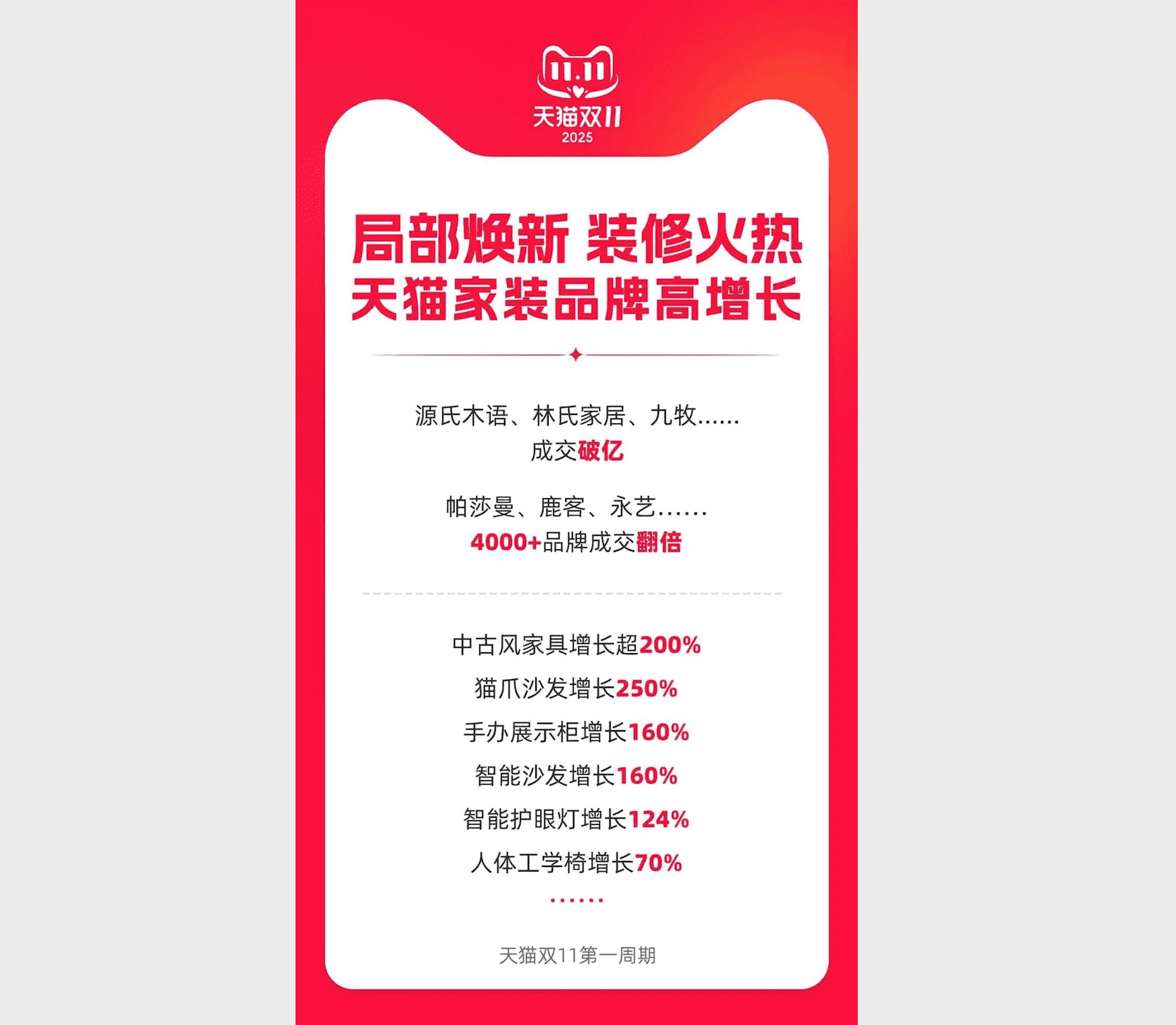
On Tmall Double 11, high growth in upgrade-focused items—such as compact sofas, display cabinets, smart eye-care lamps, and smart sofas—further highlights rising demand for localized, functional, and aesthetic upgrades, creating new growth engines for the industry.
(3)New Retail and Platform Innovation Create Fresh Opportunities
Channel transformation is intensifying—and extending beyond sales channels into organizational and operational restructuring.
First, new retail is becoming a clear
industry direction.
Internet-born furniture brands such as Yuanshi Wood and Lin’s Furniture are expanding offline, while established players continue to strengthen omni-channel strategies. Online content seeding and short-video commerce have effectively reset the competitive starting line.
Brands now must excel at both online content creation and offline experience delivery, opening new paths for standout players.
Second, platform-led offline channels are
reshaping the landscape.
JD MALL and JD City Flagship Stores have significantly improved consumer decision efficiency. Official JD data shows that during this year’s Double 11, JD MALL GMV grew 86%, with home furnishings surging 875%. A JD-operated whole-home customization store in Shenzhen surpassed RMB10 million in sales on its opening day.
Meanwhile, Tmall Genie’s whole-home smart stores—integrating lighting, security, appliances, and sleep ecosystems—have expanded to 30+ cities, with plans for 100+ core-city stores by the end of 2025.
Overall, platform capabilities in user trust, traffic quality, and fulfillment efficiency have become one of the most decisive variables for the industry.